
Sigenergy: homeowners rate it #1. So do the installers who fit it.
Inverter, battery, energy management and optional EV DC charging in one stack, from the brand that led Australian home storage sales in 2025.
 The product
Sigenergy SigenStor
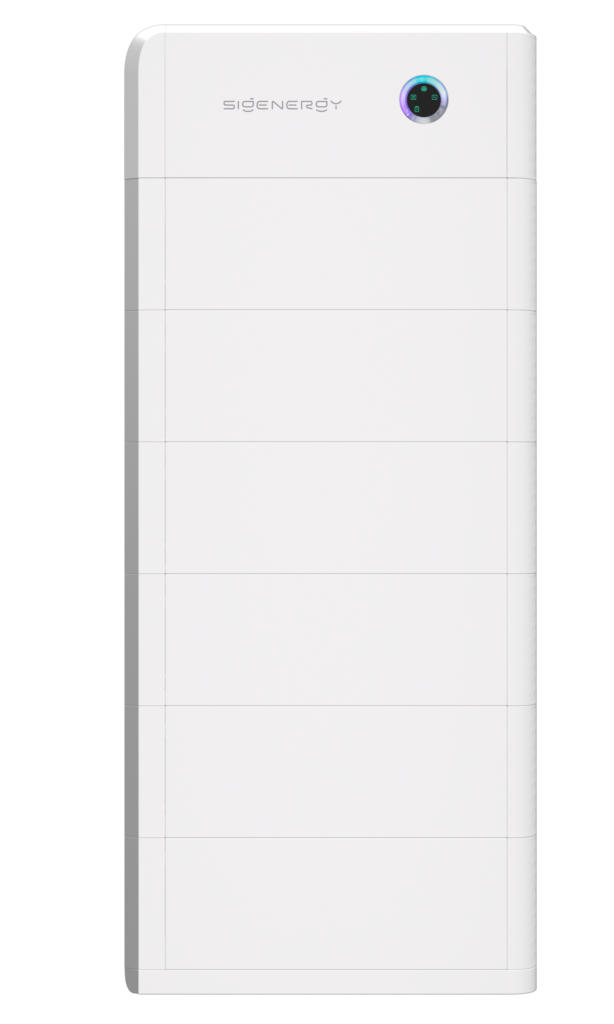
SigenStor is a modular, stackable, battery. Each module stores 8.76 kWh of usable energy, and up to six stack under a single Energy Controller. Premium 314 Ah lithium iron phosphate cells rated for 10,000 cycles, a DC optimiser in every module, and IP66 so it can live outside.
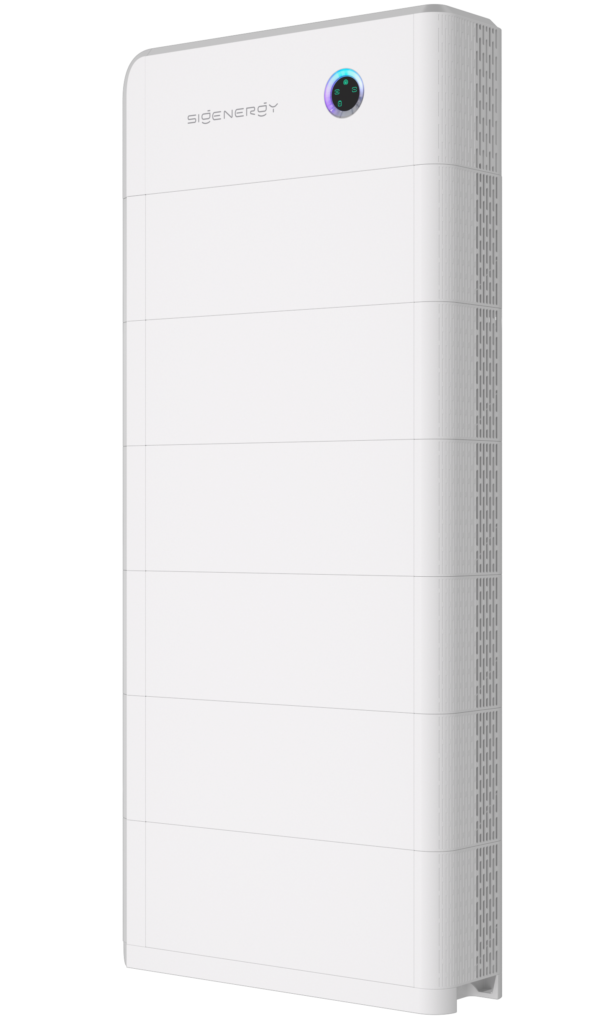
- A DC optimiser in every module, so you can mix modules of different ages when you expand later
- Guided quick connectors between modules: no hand wiring, and a faster install
- Whole-home backup available with the Sigen Energy Gateway
- Optional EV DC charging module, charging the car from solar and battery power
Take a look at the Sigenergy SigenStor
Rated number one by both sides of the job
Two separate groups, asked two different questions, landed on the same battery. One group paid for theirs. The other fits them for a living.
-
#1 with homeowners
Sigenergy tops SolarQuotes’ home battery review ranking, on 4.9 stars from 1,571 Australian homeowner reviews. That list is built from people who have installed a battery and lived with it, not from lab testing. Correct as at 2 September 2026.
-
#1 with installers
Winner of Best Home Battery at the SolarQuotes Installers’ Choice Awards 2026, with 26% of the vote ahead of Sungrow on 21%. The question put to 125 vetted installers was which brand they would choose if installing on their own house today.
-
And the EV charger too
Sigenergy also won Best EV Charger in the same 2026 awards, taking 24% against Tesla’s 12%.
-
Backed by market share
SunWiz data had Sigenergy leading Australian home battery sales through 2025, which is a different measure again: what people actually bought, rather than what they rated or recommended.
What “5-in-1” actually means
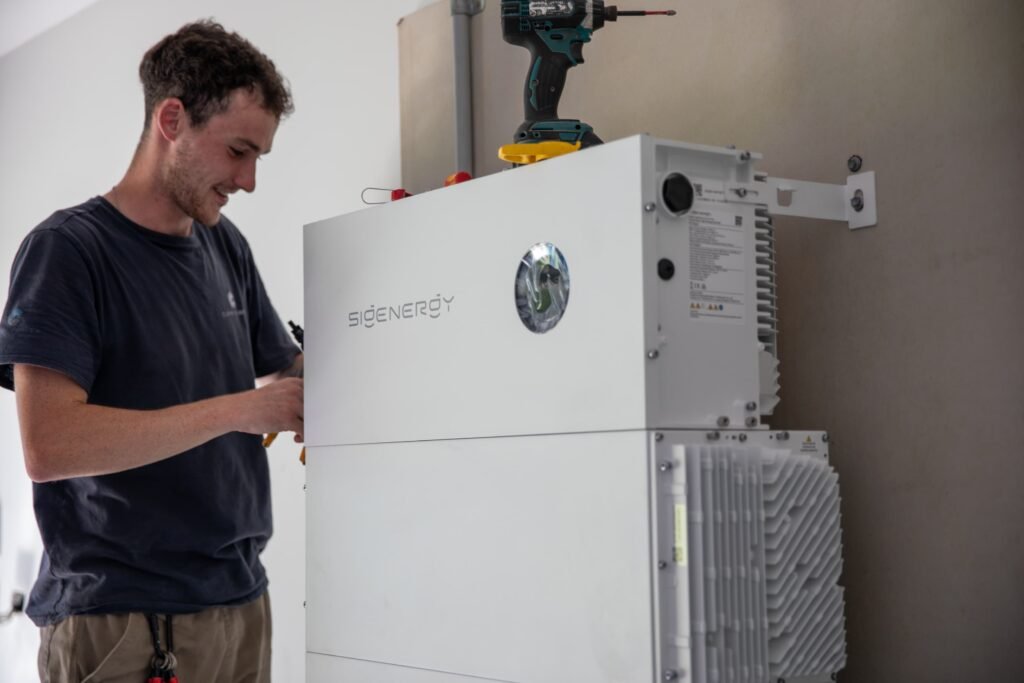
A SigenStor is a stack, not a single box. The Energy Controller on top is the solar inverter, the battery inverter and the energy management system. Battery modules sit underneath. An EV DC charging module is optional.
-
Solar inverter
Up to four MPPT trackers and a 2:1 DC to AC ratio on single phase, so you can oversize the panels and fill the battery faster on short winter days.
-
Battery inverter and battery
DC coupled, so solar charges the battery without a conversion loss. A DC optimiser in each module lets you mix modules of different ages and states of health when you expand.
-
Energy management system
The controller runs the household: self-consumption by default, time-of-use scheduling, VPP dispatch, and Sigen AI mode if you want the system to optimise around your tariff.
-
EV DC charging, optional module
Charges an EV from solar and battery DC power at 12.5 kW, upgradable to 25 kW. The hardware is bidirectional; vehicle-to-home and vehicle-to-grid depend on your car and on Australian standards being published.
-
Whole-home backup with the Energy Gateway
Zero millisecond switchover when the grid drops, whole house or nominated circuits, with a generator input available. The gateway is a separate unit we quote as part of the design.
-
mySigen app
Live energy flow by load, a Sankey view of where every kilowatt hour went, and an assistant that answers questions about your own system.
Sigenergy and Clean Power Australia
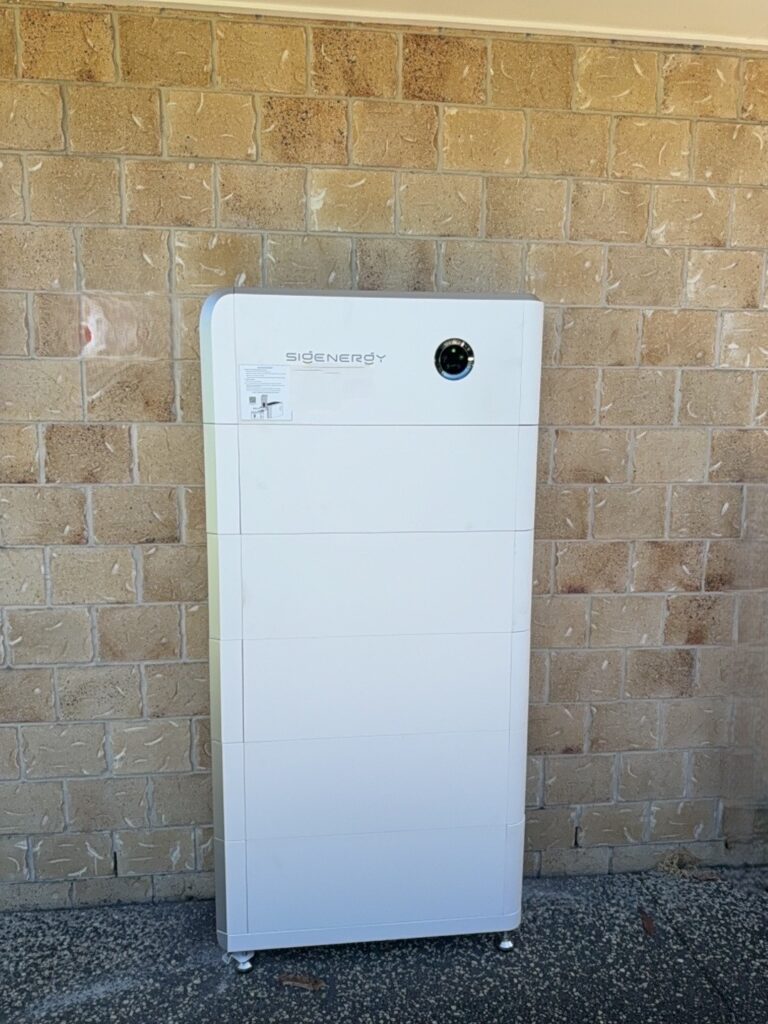
SigenStor is our flagship. It is the system we recommend when someone wants the works: whole-home backup, EV charging that runs on sunshine, and a battery that grows with the house. Our commissioning checklist includes a simulated outage, so you watch the backup work before we leave.
The relationship runs both ways. We give Sigenergy field feedback from hundreds of Australian installs, and their North Sydney service team is a phone call from ours when something needs escalating. Between the two, most issues get diagnosed remotely from the install record before anyone drives out.
- Installed across NSW, QLD, ACT and SA by local SAA accredited installers
- Federal rebate applied at quote, certificates handled by us
- Ten year warranty on the SigenStor, with claims lodged and handled locally
- VPP ready, including Powow credits for Sigenergy batteries
Three Sigenergy systems, and what they did to the bills
All three of our published case studies are Sigenergy installs. Real customers, real quarterly bills, before and after.
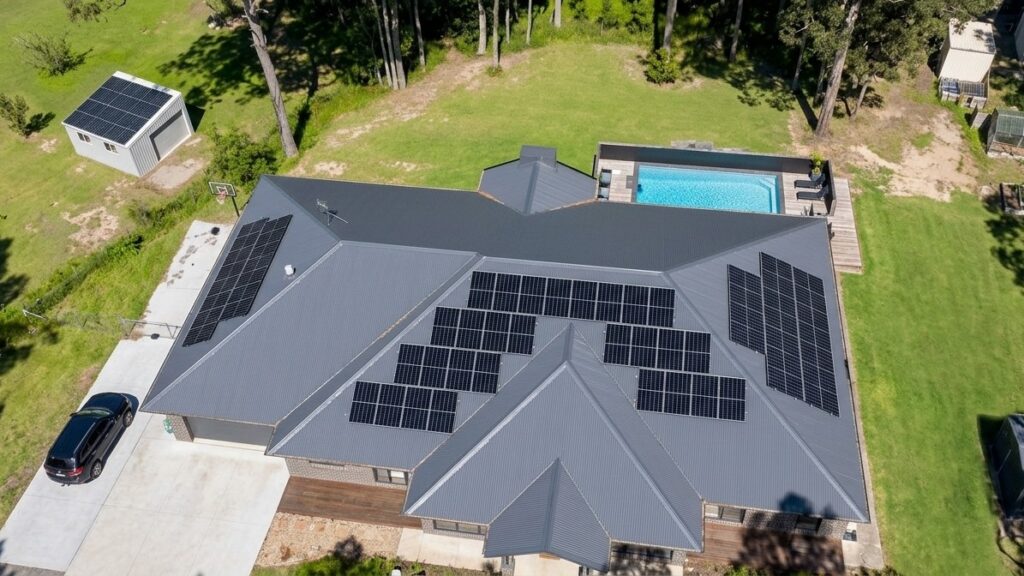
Paul & Gail, Bangalee NSW
A high-usage household on a heavily shaded block. Shade mapping drove the panel layout and the module count. Read Paul and Gail’s case study.
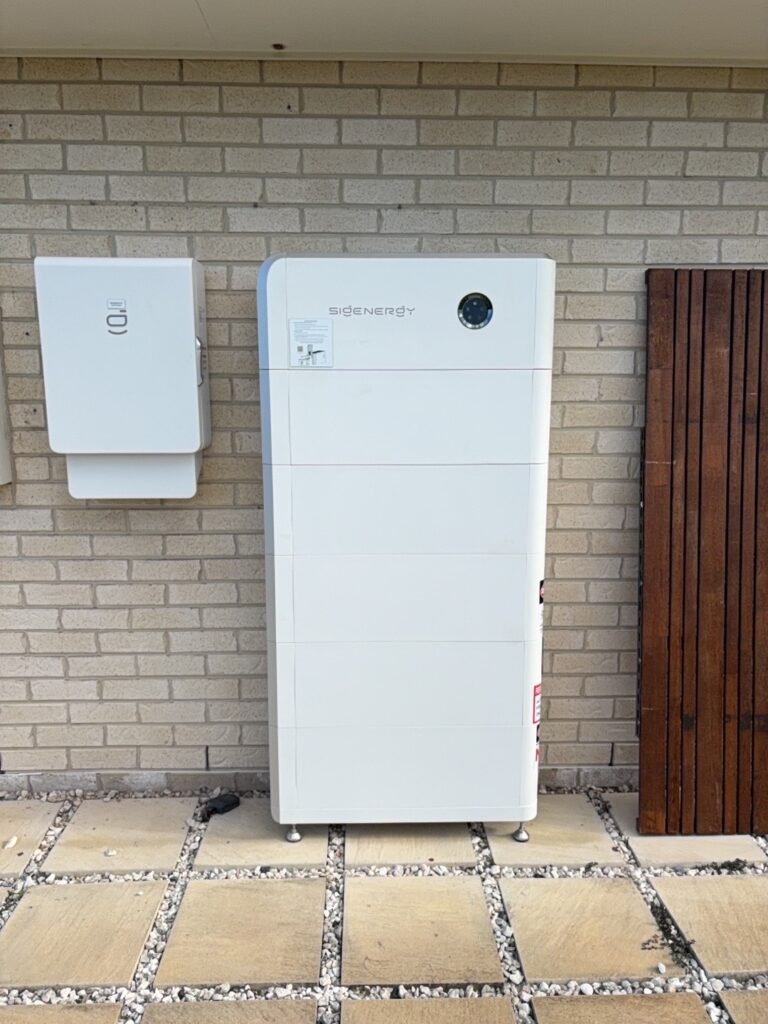
Brian, QLD
10.45 kW solar, 24.18 kWh of SigenStor and whole-home backup, enrolled in a VPP. Quarterly bill went from $320 to $28. Read Brian’s case study.
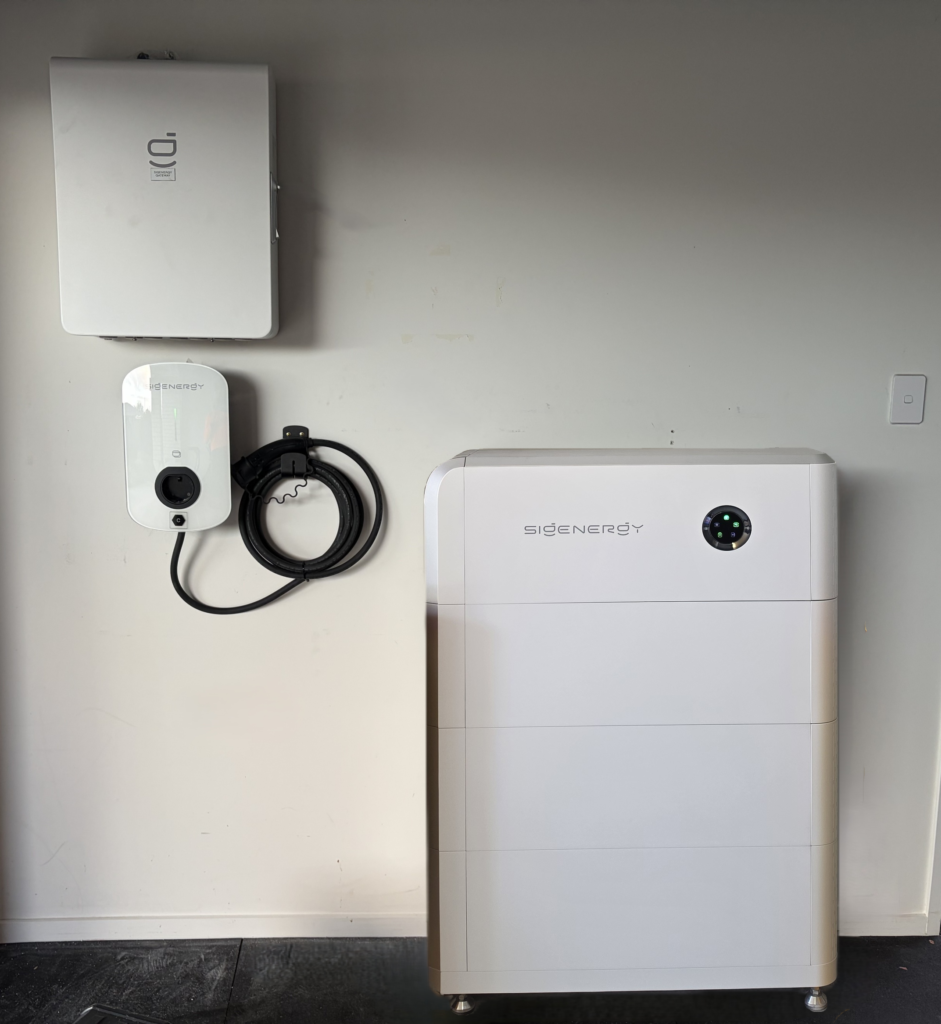
Auriol & Stuart, NSW
11.88 kW solar and 24.18 kWh of SigenStor, with an EV charger added later onto the same controller. Quarterly bill went from $1,083 to $13. Read Auriol and Stuart’s case study.
Want a system like these three?
Each of those designs started as a conversation about the bill and the roof, not a package off a price list.
What the federal rebate is worth on a SigenStor
The Cheaper Home Batteries discount is calculated on usable capacity and comes straight off our quote. These figures use the May to December 2026 rate of 6.8 certificates per kWh, at a certificate value of $37 to $40. Your quote shows the exact amount for your installation date.
One BAT 10.0, 8.76 kWh usable
59 certificates, roughly $2,200 to $2,400 off.
Two BAT 10.0, 17.52 kWh usable
109 certificates, roughly $4,000 to $4,400 off. The first 14 kWh earns the full rate and the rest earns 60%.
Three BAT 10.0, 26.28 kWh usable
145 certificates, roughly $5,400 to $5,800 off. Above 28 kWh the rate falls to 15%, which is why a fourth module rarely stacks up for a house. How the federal battery rebate works.
See that rebate on a real quote
The discount depends on the number of modules you end up with, so the figure worth knowing is the one on your own quote.
Battery, EV charger and gateway in one install
This is the configuration most of our Sigenergy customers end up with: a SigenStor with two or three battery modules, the Energy Gateway for whole-home backup, and either the built-in DC module or a Sigen AC charger for the car.
Because everything speaks to one controller, the car charges from spare solar first, the house runs from the battery through the evening peak, and the grid becomes the last resort rather than the default.
- Stack more modules later without replacing the controller
- Whole-home backup available, tested with a simulated outage on install day
- Works with the Powow VPP and other virtual power plant programs
- One app for solar, battery, EV charging and backup
Who makes Sigenergy
Sigenergy was founded in Shanghai in 2022 by Tony Xu, who previously ran Huawei’s solar inverter business, with a team drawn largely from the same background. The idea was to build the inverter, battery, EV charger and energy management as one product rather than four boxes from four suppliers. The SigenStor is the result.
It has grown quickly. Frost & Sullivan ranked Sigenergy first in the world for stackable all-in-one distributed storage in 2024, with a 28.6% share, and SunWiz data had it leading the Australian home storage market in 2025. The company listed on the Hong Kong Stock Exchange in April 2026 under code 6656, works with more than 170 distributors and over 17,000 registered installers across 85 countries and regions, and manufactures at its Nantong Smart Energy Center, a 136,000 square metre plant.
Sigenergy has had an Australian office and local service team in North Sydney since it entered the market in 2023, and its founder has described Australia and New Zealand as a core strategic market.
- Founded in 2022, listed on the Hong Kong Stock Exchange in 2026
- Led the Australian home battery market on 2025 sales
- Australian office and service team in North Sydney
- SigenStor is on the Clean Energy Council approved battery list
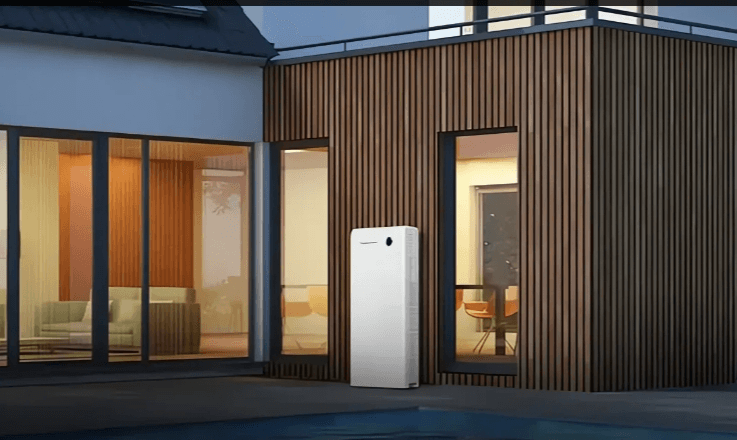
Full specification
| Specification | SigenStor BAT 10.0 |
|---|---|
| Total energy capacity | 9.04 kWh per module |
| Usable energy capacity | 8.76 kWh per module |
| Depth of discharge | 100% of usable capacity |
| Cell chemistry | Lithium iron phosphate (LFP), 314 Ah cells |
| Cycle life | 10,000 cycles, per the cell manufacturer, at 25°C and 0.5C to 60% state of health |
| Charge and discharge power | 4.6 kW continuous, 6.9 kW peak for 10 seconds |
| Modules per controller | 1 to 6 |
| Operating temperature | −20 to 55°C |
| Storage temperature | −25 to 60°C |
| Protection rating | IP66 |
| Cooling | Natural convection |
| Dimensions | 767 mm wide, 270 mm high, 265 mm deep per module |
| Weight | 78 kg per module |
| Installation | Floor standing or wall mounted |
| Pairs with | Sigen Energy Controller, 3.0 to 12.0 kW single phase or 5.0 to 30.0 kW three phase, or a Sigen Hybrid inverter through the SigenStor BC |
| Backup switchover | 0 ms load-side disruption, with the Sigen Energy Gateway |
| Standards | IEC/EN 60730-1, IEC/EN 62619, IEC/EN 63056, IEC/EN 62477, UN 38.3 |
Figures from the SigenStor BAT 6.0/10.0 datasheet. Cycle life is the cell manufacturer’s rating under its stated test conditions.
Sigenergy questions
Is Sigenergy a good battery?
It is the best-selling home battery brand in Australia, and there are reasons for that. Lithium iron phosphate cells rated for 10,000 cycles, five layers of battery protection, IP66, zero millisecond backup with the gateway, and an integrated design that means fewer boxes on the wall and one app for everything. The trade-off against a value brand like Hinen is price. If you want backup, EV charging and room to grow, it is the one we recommend.
Who owns Sigenergy?
Sigenergy Technology Co. Ltd, founded in Shanghai in 2022 by former Huawei solar executives and listed on the Hong Kong Stock Exchange since April 2026. It has an Australian office in North Sydney.
How much does a Sigenergy battery cost?
It depends on the number of modules, the controller size, whether you add the gateway or the EV module, and whether you already have solar. The federal rebate takes roughly $2,200 to $2,400 off a single BAT 10.0 module and around $4,000 to $4,400 off two. We quote the full system with the rebate already applied.
What is the Sigenergy warranty?
Ten years, covering capacity retention and product defects, with claims lodged and managed by our Australian support team. If warranty length is your deciding factor, Hinen carries twelve years as standard.
Will a SigenStor run my whole house in a blackout?
With the Sigen Energy Gateway, yes. It switches in 0 ms, so the lights do not flicker, and it can back up the whole home or nominated circuits. Without the gateway the battery shuts down with the grid for safety, which is why we quote the gateway as part of the design.
Can I charge my EV from a SigenStor?
Yes. Either the built-in EV DC module, at 12.5 kW and upgradable to 25 kW, charging from solar and battery DC power, or a Sigen AC charger managed by the same controller. Vehicle-to-home and vehicle-to-grid depend on your car and on Australian standards.
Sigenergy or Tesla Powerwall 3?
Both are good systems. Powerwall 3 is a fixed 13.5 kWh unit with Tesla’s own virtual power plant. SigenStor is modular from one 8.76 kWh module upward, DC couples an EV charger, and works with third-party VPPs. We install both and will quote whichever fits.
Was there a recall on Sigenergy batteries?
Not on the batteries. In November 2025 Sigenergy issued a voluntary recall, coordinated with the ACCC, on some single-phase energy controllers rated 8, 10 and 12 kW that were sold between March and November 2025. Three-phase systems were not affected, and neither were the battery modules. The fault was in a quick-connect AC plug that needed ferrules fitted and crimped correctly during installation, and where that was not done properly the connection could overheat under sustained load. SolarQuotes described the reported issues as occurring on improperly installed units. None of the systems we installed developed the fault. Affected controllers were replaced free of charge under Sigenergy’s national program at the time, with two extra years of warranty on each replacement, and the current plug design no longer requires ferrules.
Sigenergy or Hinen?
Sigenergy if you want the integrated system, whole-home backup and EV charging in one stack. Hinen if you want solid storage at a lower price and are happy with a separate inverter.
Where do you install Sigenergy?
Across NSW, QLD, the ACT and South Australia, from our local hubs, with SAA accredited installers on every job.
Get a SigenStor quote with the rebate already applied
Tell us how you use power in the evening and we will size the modules, the controller and the backup to it.
What our customers say


Ready to see what solar and battery could do for your place?
Tell us a little about your home and a local consultant will call you back. No obligation, no pressure.
Prefer to talk? Call 02 8311 7338.